- CapEx (Capital Expenditure) = the one-time cost to buy/build the system (hardware, facility upgrades, integration, commissioning, contingency).
- OpEx (Operating Expenditure) = the ongoing yearly cost to run/maintain it (service contract ~8–12% of CapEx + consumables, utilities, staffing).
- Terawatt (TW) systems: ~ $1M–$5M+ depending on rep-rate, bandwidth, and diagnostics.
- Petawatt (PW) systems: ~ $8M–$40M+ depending on architecture (Ti:Sa CPA vs OPCPA), number of stages, vacuum compressor, and facility upgrades.
- Operating & service: typically 8–12% of CapEx/year, plus consumables and staff.
- Lead times: 9–18 months for turnkey builds; complex green-field labs and PW compressors can exceed 24 months.
- Jump to the Cost Calculator to generate a line-item estimate (CapEx + OpEx) and a printable stakeholder summary.
In my work designing terawatt and petawatt laser systems, I see the same trap derail budgets: quoting “peak power” without pricing the physics that makes it real. The sticker shock isn’t the oscillator—it’s the pump chains sized for your repetition rate, the bandwidth that forces premium gratings, and the moment you cross into vacuum compressors, where costs step—not drift—upward. Add diagnostics, timing, UHV mechanics, and facility upgrades, and a neat estimate can balloon fast. This guide cuts through the wishful thinking: I’ll translate spec sheet ambitions into line-item realities, show you where money actually goes (and why), and give you a planning-grade calculator to model CapEx vs. Year-1 OpEx for your target power, pulse duration, and rep-rate. If you’re about to scope a 50 TW workhorse or a flagship 1–10 PW system, start here—and avoid the most expensive sentence in laser design: “We’ll figure that out later.”
Table of Contents
What Actually Drives Cost? (The Physics in Plain English)
- Peak power target (TW vs PW): Ppeak=Epulse/τPpeak=Epulse/τ. Higher energy and shorter pulses inflate stretcher/compressor specs, grating size/quality, and damage-threshold margins.
- Repetition rate: Moving from 1–10 Hz to 10–100 Hz or kHz pushes average power and thermal load → bigger pump budgets, more aggressive cooling, tighter compressor design. Costs scale nonlinearly.
- Gain medium & architecture:
- Ti:Sa CPA: Mature ecosystem, broad gain, sub-30 fs; pump and premium gratings dominate cost at PW.
- OPCPA: Higher efficiency and bandwidth; needs precise ps-pump synchronization and crystal QA across multiple stages.
- Bandwidth / pulse duration: Sub-20 fs or ≤10 fs brings premium dielectric/gold gratings and dispersion control, plus larger crystal inventory (OPCPA).
- Compressor type: Air vs vacuum (UHV chambers, low-scatter gratings, large apertures). Vacuum is a step-function cost at PW.
- Pump lasers: Green ps/ns pump chains are often the single largest budget item; stage count and energy per stage dominate.
- Diagnostics & controls: Wavefront sensors, SPIDER/FROG, spectrometers, energy meters, timing & auto-alignment; more automation → higher NRE but lower ops burden.
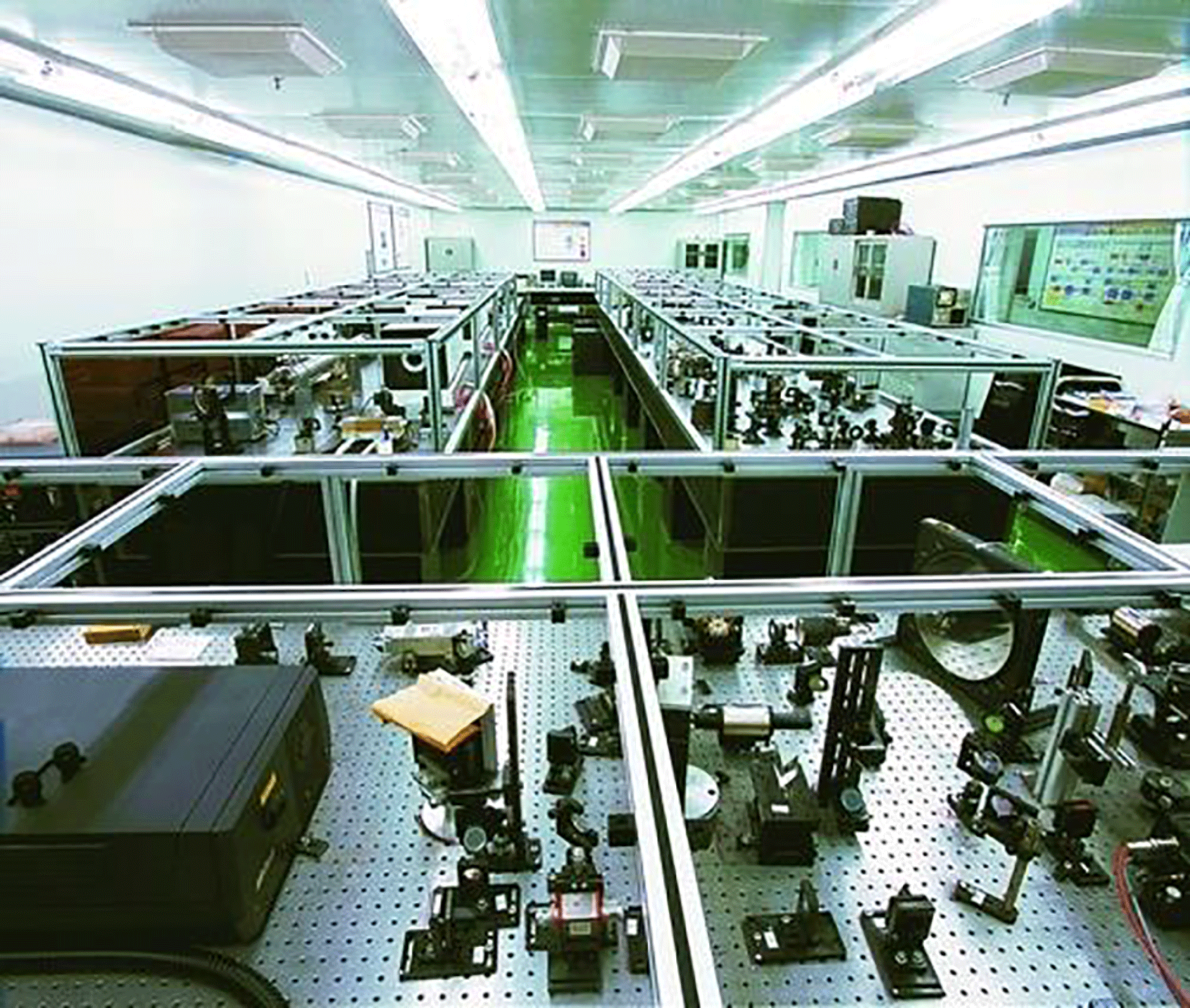
- Facility: Floor loading, chilled water, 3-phase power (often 480 V), HVAC stability, vibration isolation, laser safety interlocks, sometimes radiation/EMC.
- Integration & risk: Custom mechanics, tight tolerances, software interlocks, commissioning time—all add real dollars.
Architecture Snapshots
Choosing between them in practice: your architecture isn’t a brand choice—it’s a constraint choice. If you need kHz-class average power with ≤20 fs pulses and wavelength flexibility, OPCPA tends to win on efficiency—provided you can meet ps-pump synchronization and crystal QA. If your brief is ≤10 Hz with ultra-short pulses and high pulse energy, Ti:Sa CPA remains a fast, low-risk path with a mature supply chain (the big step is the vacuum compressor at PW). If your science tolerates hundreds of fs to ps pulses and prioritizes joules over the very shortest duration, Nd:Glass CPA scales gracefully to huge energies—at facility scale. As you down-select, anchor specs around rep-rate, target pulse duration/bandwidth, compressor environment (air vs vacuum), and facility limits—those four levers drive ~80% of cost and lead time.
Ti:Sapphire CPA (TW → single-PW)
Pros: Proven vendors, high gain, sub-30 fs capability; simpler timing than OPCPA; rich component ecosystem.
Cons: Lower efficiency; rep-rate pushes thermal and pump costs; premium broadband gratings; PW often requires vacuum compressor.
Typical use: 0.1–10 PW at ≤10 Hz; 10–100 TW up to ~kHz (complex).
When it wins: You need ultrashort (<20–30 fs) pulses with high pulse energy at modest rep-rate, and you want the most mature supply chain.
Cost notes: Budget heavy for pump chains and low-scatter gratings; vacuum compressor is a step-function at PW.
OPCPA (TW → multi-PW)
Pros: High efficiency, very broad bandwidth (≤10–20 fs feasible), flexible wavelengths; well-suited to high-rep-rate TW.
Cons: Tight ps-level synchronization; more stages; crystal procurement and QA; control/timing complexity.
Typical use: kHz-class TW sources; PW with vacuum compressor and staged ps pumps.
When it wins: You need kHz average power with ultrashort pulses and are prepared to engineer synchronization and crystal logistics.
Cost notes: More spend on ps pump chains, timing electronics, crystal inventory and QA; gratings can be smaller than Ti:Sa at the same peak power.
Nd:Glass CPA (ps-class, high-energy PW)
Pros: Scales to very large apertures and J–kJ pulse energies; rugged gain medium; mature large-facility know-how.
Cons: Narrower bandwidth → longer compressed pulses (hundreds of fs → ps); large, heavy optics; low rep-rate (single-shot to few Hz); substantial facilities.
Typical use: ps-class PW drivers for HEDP, shock physics, ion/proton sources—where fluence/energy matters more than the very shortest pulse.
When it wins: You can accept >200 fs–ps durations and already have (or plan) facility-scale power/cooling and large compressors.
Cost notes: CapEx dominated by large-aperture amplifiers, high-energy pump rooms, and meter-class compressors; OpEx leans toward optics handling, cooling, and pump maintenance rather than broadband dispersion.
Hybrid paths: Common mixes include Ti:Sa or OPCPA front-ends (for clean, broadband seeds) feeding glass power amplifiers (for energy scaling), or Ti:Sa systems with later OPCPA stages to extend bandwidth at the target station.
Line-Item Cost Ranges (Typical 2024–2026 Budgets)
Line-Item Cost Ranges (Typical 2024–2026 Budgets) {#lineitems}
Ranges reflect custom integrations, UHV quality, and reputable vendors. Your exact quote depends on specs and risk profile.
| Subsystem | TW-class (indicative) | PW-class (indicative) |
|---|---|---|
| Front-end fs oscillator + preamp | $50k–$150k | $80k–$250k |
| Stretcher + dispersion control | $80k–$250k | $150k–$400k |
| Regenerative / multi-pass amplifier (Ti:Sa) | $200k–$700k | $600k–$2.0M |
| OPCPA crystal stages (per stage incl. mounts) | $40k–$120k | $80k–$250k |
| Pump lasers (per chain) | $250k–$1.5M | $1.0M–$6.0M+ |
| Gratings (set; gold/lamellar, low-scatter) | $120k–$400k | $500k–$1.5M+ |
| Compressor (air) | $80k–$300k | — |
| Vacuum compressor (chamber + gratings) | — | $800k–$3.0M+ |
| Beam delivery & large-aperture optics | $100k–$350k | $300k–$1.2M |
| Diagnostics (WFS, SPIDER/FROG, energy, cameras) | $120k–$400k | $250k–$800k |
| Timing & synchronization | $50k–$200k | $120k–$400k |
| Controls & safety interlocks | $50k–$250k | $120k–$450k |
| Mechanical (tables, enclosures, UHV, mounts) | $150k–$500k | $400k–$1.5M |
| Facility upgrades (HVAC, power, CW chiller) | $100k–$500k | $300k–$1.5M |
| Integration, software, NRE, testing | $120k–$400k | $400k–$1.5M |
| Commissioning & training | $80k–$250k | $200k–$700k |
| Contingency (10–20%) | scoped | scoped |
| Total typical | $1.0M–$5.0M+ | $8M–$40M+ |
Custom TW/PW Laser Budget Estimator
Plan CapEx, Year-1 OpEx & lead time in seconds. For planning only.
Budgeting Examples:
Example A — 50 TW @ 10 Hz, Ti:Sa (air compressor)
Balanced diagnostics, modest facility upgrades.
Expectation: ~ $1.5M–$2.5M CapEx; OpEx ~ $150k/year.
Example B — 1 PW @ 1–10 Hz, Ti:Sa (vacuum compressor)
Premium gratings, large-aperture delivery, upgraded HVAC/power.
Expectation: ~ $10M–$18M CapEx; OpEx ~ $1.1M/year.
Example C — 100 TW @ 1 kHz, OPCPA (advanced automation)
High-average-power ps pumps, crystal QA, advanced sync.
Expectation: ~ $4M–$8M CapEx; OpEx ~ $0.6–$1.2M/year.
Build vs Buy
- Turnkey: Faster, warranty, lower technical risk → higher sticker price.
- Custom build (with SI partner): Optimized for your science; longer lead, requires in-house expertise.
- Hybrid: Procure critical subsystems (ps pumps, gratings, vacuum chambers) and integrate locally.
Tip: Budget 10–20% contingency for integration risk and early-life optical replacements.
Hidden (but Real) Costs to Plan For
- Laser safety: Interlocks, eyewear inventory, beam dumps, curtains, training.
- Metrology: Reference spectrometers, power/energy calibration, timing standards.
- Software & data: Control licenses; high-rate data storage/backup.
- People: Expect 0.5–2.0 FTE operators/engineers for kHz-class systems.
FAQs:
How long do these projects take?
Typical 9–18 months; PW vacuum compressors and new labs can exceed 24 months.
What’s the biggest cost driver?
Pump chains and gratings/compressor at PW scale; repetition rate multiplies average-power costs.
OPCPA or Ti:Sa—what’s cheaper?
For kHz TW, OPCPA can be more cost-efficient. For ≤10 Hz PW, Ti:Sa remains competitive given a mature supply chain.
Can I upgrade later?
Often yes (extra compressor aperture, spare crystal mounts, scalable pump architecture), but it’s cheaper to design for growth.
What about service?
Budget 8–12% of CapEx/year for support, parts, and periodic realignment.
Download the PDF Cheatsheet Book a Free 30-min Consult Request a Vendor RFP Package